A forum dedicated to the discussion of current events, personalities, and topics in light of scripture, the Gospel message of Jesus, and the imperatives of Christian discipleship.
And all the men and women merely players; They have their exits and their entrances, And one man in his time plays many parts, His acts being seven ages."
The eldest of our two adult daughters is moving out of the state today. Shakespeare's words capture my emotions, as I witness the first of many changes in our respective lives.
If you live long, you'll inevitably play a lot of roles.
I remember moving out of state for the first time as an adult child. I saw it all from the child's perspective, of course. Now, as a parent, I see a bit of what my own parents were seeing -- and feeling -- as we went about routine tasks, and silently counted-down to the moment when we said our good-byes.
Good-byes are hard, even when you've been looking forward to "launch time," such as the last day of an unpleasant job; or the first day of a great adventure. Good-byes are hard because saying "good-bye" is the prelude to a change for just about everyone in the "cast." Good-byes are hard because no change comes without uncertainty.
Lost in the modern usage of the word "good-bye," is its literal Middle English origin: "God be with you." Therein, for me, is the key to surviving every departure with its promises for success and its risks for failure: The invited presence of God.
MSGT Freddie Lee Mahone, U. S. Army (Retired) died on August 12. He was 82 years old. The words below are my funeral sermon for my friend, who was also a friend to many others in his neighborhood, his extended family, and the U. S. Naval Academy Chapel community.
He was buried, with military honors, in the Maryland Veterans Cemetery, Crownsville.
This passage from the Old Testament book of Ecclesiastes may seem to be a strange text for a funeral sermon – particularly for a man who had lived for more than eight decades; a man who had fought in two wars; a man who had served our nation for 30 years as a soldier, and 30 additional years as a federal civilian employee.
However, the truth about the funeral sermon is that it is not for the person who has gone – as the folks in Freddy’s native Georgia might say – “from labor to reward.”It is for those of us who remain.
I first met Freddy – who insisted that I call him by his first name – one Sunday morning before services in the upstairs chapel.He was an usher and a cross-bearer in the procession.(He was one of the gentlemen who comprised our usher corps, and not all of them could easily carry the heavy processional cross the 80 yards or so from the Chapel entrance to the altar!)
But I got to know Freddy as I encountered him – at 70-plus years – running the perimeter of the NavalAcademy grounds.Occasionally, we would run together.
I learned that he was devoted to his wife, who at the time was seriously ill. He had great affection for the NavalAcademy, despite being an Army guy.He loved this Chapel community.This was his church!
He had seen a lot.He had done a lot.And he knew a lot, although he would be the last person to let-on, because he was a man of great humility.
The resonance of the final chapter of Ecclesiastes for we who remain is in the preacher’s admonition to remember our Creator while we are young.
You may be 100 years old, but you are younger today than you will be tomorrow.
Today: Are you living for God?
Today: Have you time for God?
Today: Are unalterably committed to the things that are always right; the things that never deceive; the things that transcend time and eternity?
The words of Ecclesiastes are as relevant today to persons who are “young at heart” as they were when first written 3,000 years ago to people who were “young in fact.”To those individuals – regardless of chronological age – for whom tomorrow is bright; and for whom life is as full and varied as a Sunday buffet, the preacher has three words: Remember your Creator!
Scripture tells us that there are three basic tactics employed by the devil to help us to forget God: (1) The lust of the flesh: What feels good to our senses; (2) The lust of the eyes: What looks good, either literally or figuratively; and (3) The pride of life: The sense that life is good, and that, for you, it always will be good.
Yet, the preacher says that if we live long enough, our life will change – and at the end of life, we each must stand before God.
When that day comes, and we each stand before God, what will be in our memory?Recollections of treasures reserved for us; or the reality of treasures laid up in heaven, where moth and rust cannot corrupt; and where thieves cannot break through and steal?
When that day comes, and we each stand before God, what will be in our memory?Recollections of our hobbies, pastimes, and occupations; or the assurance that God has remembered the visits to those whom others seem to have forgotten: The sick, the shut-in, the prisoner, and the elderly?
When that day comes, and we each stand before God, what will be in our memory?Will it be our Creator?Will we recognize Him as our Father?Will he recognize us as His children?
Our Hope – Jesus Christ – came to this earth; lived, was crucified, buried and resurrected, that you and I might become the Children of God by believing in Him.If the Spirit of God is speaking to you; urging you to remember your Creator, will you now come to Him?
Jesus says this: “Behold, I stand at the door and knock.If anyone hears my voice and opens the door, I will come into him and eat with him, and he with me.” (Revelation 3: 20)There is no better time than now.There is no better place than here.
As a disciple of Jesus, this was Freddie’s hope.It is my hope, too.
I envision that when I see Freddie in heaven, we will, again, go for a run; but not before we have added our voices to the heavenly assembly, gathered to remember in eternity our Creator, Redeemer, Lord, and God: “Holy, Holy, Holy! Amen!”
My friendship with Bradford E."Brad" Ableson began 20 years ago when the U. S. Navy ship he was serving as chaplain visited Hong Kong.
As the chaplain assigned to the U. S. Navy Contracting Department in the then-British Crown Colony, I was a member of the party that greeted each visiting U. S. warship. Maybe it was the fact that we were both from the great "fly-over" land more commonly known as the Great Plains (he from Oklahoma, and I from Kansas); or maybe it was that we were both Navy chaplains having the time of our young lives in the Western Pacific theater, but we spent a lot of time together during his ship's five day port visit.
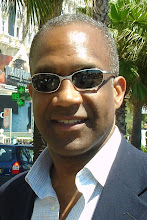
Brad was witty, irreverent, insightful, intellectual, and deeply spiritual: Qualities not commonly found in coexistence in clergy (especially in my case, which made Brad all the more fun to be with). He was a man of great accomplishments: Graduating from the Yale Divinity School (the photo above was taken from a recent Yale Divinity School newsletter), and the Columbia Theological Seminary in Atlanta, where he earned a Doctor of Ministry degree. However, Brad would never tell you these things. You'd have to read it, or hear it, elsewhere. (Click here to read more!)
I remember meeting Brad and his lovely wife, Julia, in the San Francisco International Airport during one of my many stop-overs between Hong Kong and Kansas. It was my first time meeting Julia. It was apparent that they not only loved one another, but that they loved being with one another.
Some ten years or so passed before Brad and I renewed our friendship. At that time, Brad was in the Navy Chief of Chaplains Office in Washington, D. C., and I was in Pearl Harbor, Hawaii. In the intervening years, he had served two tours with the Marine Corps, including time in combat during the first Gulf War; and he was the chaplain at the Presidential Retreat at Camp David during the Clinton administration.
When he landed in the Chief of Chaplains Office, he cheerfully became my greatest and most reliable source for information about the machinations of the Chaplain Corps. He would often preface his statements with the phrase, "The tom-toms are saying. . . "
Brad died at age 50 on Tuesday, February 17, after a long bout with cancer. (Click here for obituary.) We last saw each a year ago at a conference for senior Navy chaplains. It was going to be the last of the annual meetings for us, since Brad and I were retiring from active-duty long before the next one.
February 17 is also the 50th birthday anniversary of my brother, Olian Calvin Alexander. Is it ironic that as I celebrate the birthday of one brother, I mourn the death of another?
Certainly, the day is coming when I will again enjoy the company of all of my brothers and sisters in Christ. Brad will be there. Indeed, Brad is there now.
Several months ago, a friend of mine sent to me a short article on relationships titled: "A reason, a season, or a lifetime." I found it useful because it helped me to come to terms with the inevitable phases of human friendship.
I have been blessed -- many times over -- by people from each of the three categories: Season, reason, or lifetime. I have often wondered what has become of those with whom I had worked, played, helped, or had received help. I have grieved over relationships that I have starved of necessary attention because of self-centered interests or laziness. In my heart, I know that my life would have been fuller and richer had I only reciprocated. I know that it is not humanly possible to redeem these situations. Some of my greatest champions died long ago.
Oswald Chambers wrote: "True friendship is so rare on earth. It means identifying with someone in thought, heart, and spirit." So, I have decided to dedicate 2009 to my friends; or, more accurately, to being the kind of good friend that many others have been to me -- whether for a reason, a season, or a lifetime.
While I am in the moment of using cliches and the words of others, allow me this borrowed thought: "A true friend doubles our joy and divides our sorrows." With that kind of help, 2009 can be the best year yet!